
What is curiosity good for? For most of human history, the answer was obvious: fire, tools, shelter, crops, cures. Each one the product of someone who wanted to solve a life or death problem. Today, the answer to that question is less obvious. Curiosity didn't disappear, but rather, it got a boss.
Once problems stopped being matters of life and death, that boss preferred answers that pay soon, with minimal risk and the highest shareholder return. Today, with Artificial intelligence making the gap between knowing and not knowing almost imperceptible, what is the future of human curiosity?
It is easy to blame AI, but the human created machine is not the cause. Society has created the conditions that replaced human curiosity long ago. Indeed, AI is accelerating this loss, but reclaiming our curiosity is our responsibility.
The Organizational Immune System
Curiosity lives between a question and its answers. The mission of the modern company has been to reduce that gap as fast as possible and narrow the number of questions asked. So, while “curiosity killed the cat” may not be in the syllabi of business schools, it is proving to be the case in real-life examples.
Research shows that the number of papers and patents introducing genuinely new ideas has been falling for decades, while the share extending or recombining established ones has risen dramatically. (1) Over a generation, as businesses have maximized extracting value over exploring new markets, our capacity for inquiry has atrophied along with its budget line. Line extensions, feature improvements, and optimization are championed because they deliver the legible quarterly metrics shareholders expect.
Risk frameworks, compliance regimes and consensus-driven review boards crush curiosity. Where curiosity is illegible to performance management, it dies a thousand deaths with each performance review. Audit culture does to our intuition what automation did to our manual skills. (2)
Only 22 percent of US workers surveyed by Merck reported being curious at work, and 60 percent of all surveyed workers reported barriers to being curious at work. (3) Critical to applying human ingenuity is employee engagement. Just 20 percent of the world’s workers are engaged, the lowest since 2020, resulting in a loss of productivity of over $10 trillion, according to Gallup’s 2026 State of the Global Workplace. (4)
Good Enough Answers
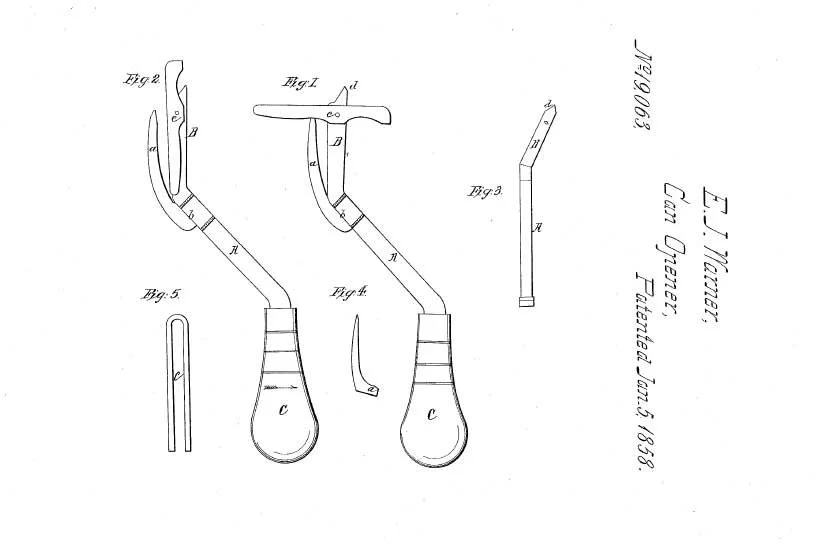
Answers can make questions obsolete. As the military maxim often attributed to Napoleon goes, “An army marches on its stomach.” Seeking to solve this problem, Nicolas Appert published his findings in 1810 that sealed, cooked food could be kept for years. By 1813, the British army marched with preserved food rations in sealed tin containers, from which they were instructed to “cut round the top near the outer edge with a chisel and hammer”. A dedicated can opener was invented in the 1850s. The hard problem was solved, and a generation went without asking the next question.
MIT developmental psychologist Laura Schulz points out that when teachers show children how to use a particular object, children tend to lose curiosity about how the object works. When teachers don’t show children how to use a particular object, children eventually figure out the object’s other functions on their own. (5) Instruction is efficient. It creates a ceiling. Generative AI is like that teacher, always available, always efficient, and always shows the one way a toy works. Nothing is questioned. The utility is captured, and discovery becomes irrelevant. The cost is measurable. In a twelve-week study of more than 200 chess students, those who could ask an AI for help whenever they wanted improved by 30 percent. Those who received tips only at moments the system chose improved by 64 percent. (6)
In the 1970s, a line of British telecom engineers were already telling each other, “The factory of the future will have only two employees, a man and a dog. The man will be there to feed the dog. The dog will be there to keep the man from touching the equipment.” (7) Technology has always been and will always be a part of “getting the job done” better. But a fundamental, nearly cellular-level change is happening. AI does not kill curiosity, intuition, or innovation. It does something more dangerous. It lets individuals kill them themselves while supercharging the institutional habits that have suppressed curiosity for decades.
Augmented Curiosity
Access to answers has historically been restricted. It took time and fortune to locate the answers to life's most pressing questions. AI is pushing its price toward zero. The fastest answer no longer wins. The biggest advantage goes to those who ask the most original questions.
Curiosity is not efficient, and that is its value. The fastest way to an answer is not always the right way. The workplace rewards closure, but often the people least rewarded are those who poke holes in the irrational beliefs of the status quo. AI is instant closure. The greater danger is not that AI gives bad answers. It is that it gives good answers too quickly.
The answer is not to rely on AI less, but to demand more. Call it Augmented Curiosity. The goal is to leave a person more curious after an AI interaction than before. This is where friction returns. In an earlier essay, I claimed great organizations don't choose between function (speed, clarity, scale) and friction (the deliberate pause…) but to orchestrate the dance between the two. (8)
Augmented Curiosity uses AI on both sides of the loop: the human finds the gaps, then partners with the machine to explore them. Only when the dots start connecting does the human hand the work to AI to confirm and scale the insight.
The Augmented Curiosity Cycle
At work, the process breaks down into five steps: Notice, Predict, Question, Explore, and Reopen.
Notice. Humans lead the way in identifying what's not working as well as expected in the buyer experience or on the factory floor. Increasingly, companies ask AI to capture and summarize these pain points. But AI can only surface the anomalies someone has already noticed and put into words, and decades of experience tell us most never are. So, in the first step, the human takes the lead to see what AI can't: the undigitized street-level reality, the conversations never recorded, the noncustomer actions never observed. That is where managers still need to go and discover for themselves.
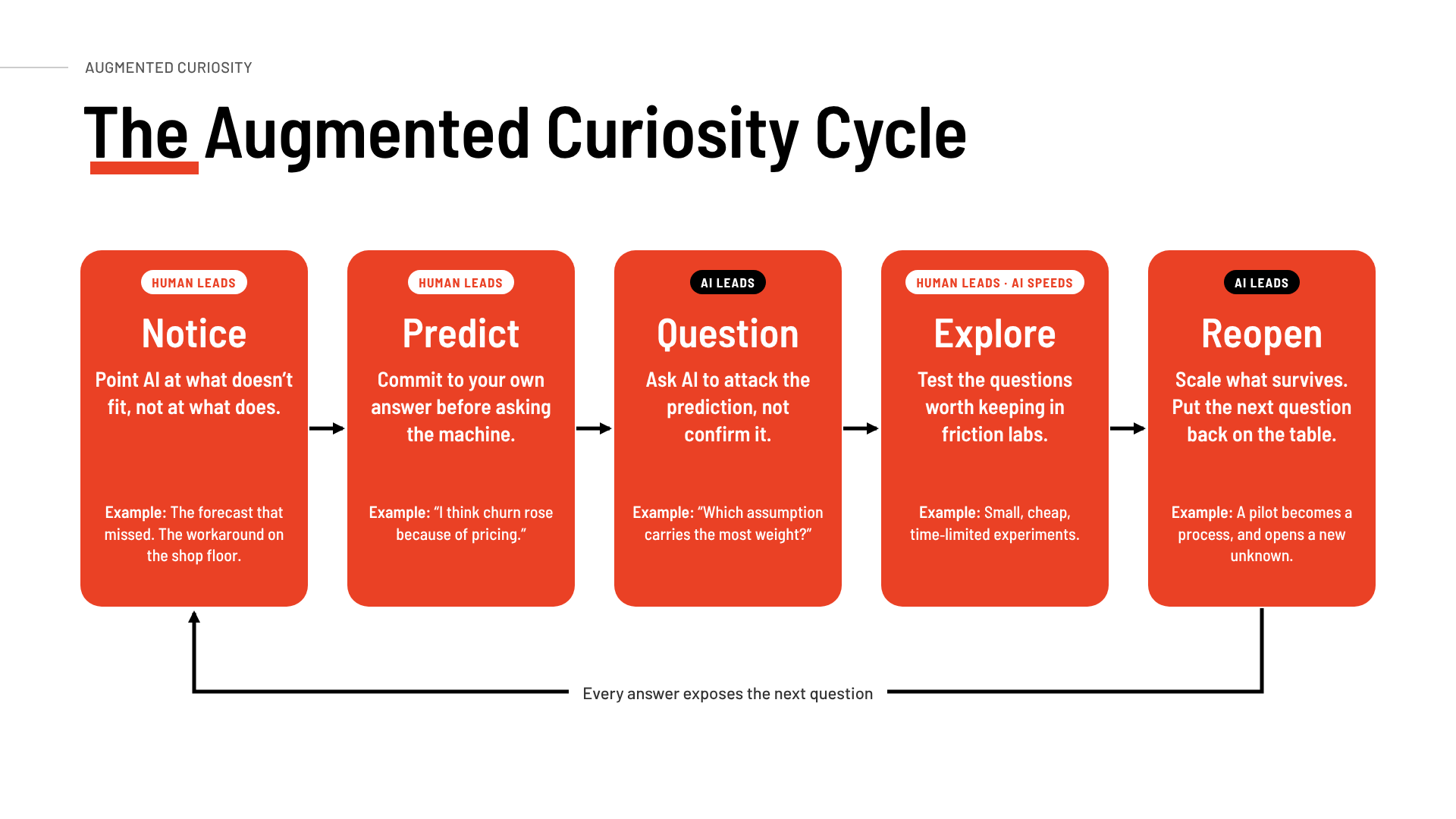
Predict. State your prediction out loud. Your prediction turns a fuzzy interest into a physical yearning. Neuroscientists Matthias Gruber and Charan Ranganath claim that what motivates curiosity is the existence of a gap between our expectation and reality. When we deem this gap important, we're motivated to learn more to satisfy our curiosity. (9) You need to commit to your prediction before you consult the machine. Otherwise, the answer arrives before the gap does.
Question. Here, AI comes into the picture as an adversary. Prompt it to ask questions about where your prediction is wrong, which assumption matters most, and what it would take to change your mind. The objective is to utilize the machine to create more effective questions.
Explore. The types of questions that are worth keeping are used in friction laboratories. Mentioned in the last article, these are low cost spaces that allow teams to test ideas outside of the slipstream. These are human-led explorations, but alongside artificial intelligence. Experiments that would typically take weeks can now be completed in a fraction of the time.
Reopen. Once scaled and deployed, look for new gaps. Have your AI companion on alert for new anomalies during rollout. Every answer the AI gives during scaling exposes new unknowns. The cycle ultimately ends in more questions.
Leading from Uncertainty
To start, there are three things leaders should do.
First, leaders should choose the focus area. A business has many different processes and not every process should have friction. Some processes, like creating and collecting invoices or running a production line, can and should be smooth processes. A leader’s focus, however, should be on the drivers of growth: strategy, product, customers, and, most importantly, noncustomers.
Second, make it a budget line item. Exploration that needs to justify itself each quarter will never survive the crunching reality of a functionally focused organization. Curiosity needs its own allocation of time, money, and structure, protected from the metrics used to judge the core business.
Third, measure curiosity. Innovation output is a lagging indicator and is measured by every company. Curiosity is the leading indicator and is generally ignored. Measure it by the number of assumptions you overturn and the number of rules and beliefs you test.
You’ll have to choose between keeping your functional business running and remaining curious. This choice will be presented to you one interaction at a time. Generally, we’ll choose the option that seems to give the best answer. Reverse this way of thinking. This works in most cases because the previous answer was good enough. The previous answer to a business problem is generally good enough to move on. However, we can be better, and question why.
For years we opened canned food with a hammer and chisel because that’s what was good enough. Today we’ve replaced that problem with a multitude of answers, but every answer feels good enough. Augmented Curiosity is the discipline of refusing to stop there
——————
For more on how leaders can thrive when intelligence is abundant, see my book with Rajeev Kapur, Intelligence as a Commodity: Human Judgment as a Competitive Advantage (Wiley, December 8, 2026), available for pre-order: https://a.co/d/0gTKK7Mc
——————
(1) Michael Park, Erin Leahey, and Russell J. Funk, "Papers and Patents Are Becoming Less Disruptive over Time," Nature 613, no. 7942 (2023): 138–44.
(2) Lisanne Bainbridge, "Ironies of Automation," Automatica 19, no. 6 (1983): 775–79.
(3) Merck KGaA, Darmstadt, Germany, "Merck KGaA, Darmstadt, Germany Presents First Curiosity Report in the U.S. to Help Drive Innovation," press release, PR Newswire, October 21, 2015, https://www.prnewswire.com/news-releases/merck-kgaa-darmstadt-germany-presents-first-curiosity-report-in-the-us-to-help-drive-innovation-300163542.html.
(4) Gallup, State of the Global Workplace: 2026 Report (Gallup, Inc., 2026). https://www.gallup.com/workplace/349484/state-of-the-global-workplace.aspx
(5) Elizabeth Bonawitz, Patrick Shafto, Hyowon Gweon, Noah D. Goodman, Elizabeth Spelke, and Laura Schulz, "The Double-Edged Sword of Pedagogy: Instruction Limits Spontaneous Exploration and Discovery," Cognition 120, no. 3 (2011): 322–30.
(6) Stefanos Poulidis, Hamsa Bastani, and Osbert Bastani, "Self-Regulated AI Use Hinders Long-Term Learning," SSRN working paper, https://doi.org/10.2139/ssrn.5604932; summarized in "How On-Demand AI Assistance Undermines Learning," INSEAD Knowledge, March 17, 2026, https://knowledge.insead.edu/responsibility/how-demand-ai-assistance-undermines-learning.
(7) Garson O'Toole, "The Factory of the Future Will Have Only Two Employees, a Man and a Dog," Quote Investigator, January 30, 2022, https://quoteinvestigator.com/2022/01/30/future-factory/.
(8) Jason Hunter, "Paid to Not Know" https://corners.works/insights/paid-to-not-know
(9) Matthias J. Gruber and Charan Ranganath, "How Curiosity Enhances Hippocampus-Dependent Memory: The Prediction, Appraisal, Curiosity, and Exploration (PACE) Framework," Trends in Cognitive Sciences 23, no. 12 (2019): 1014–25.