
The competitive advantage of not knowing.
Managers are paid to know, and paid to do. That's why, now that machines know more and know it faster, managers are optimizing themselves out of a job. For two centuries, business intelligence was about knowing more than your competitors. Then it was about who knew it faster. Finally, who knew more faster. (1) Today, intelligence is a commodity. Now the valuable thing is the nerve to not know.
When we ask executives which human elements are central in an AI-driven business, the top three are almost always judgment, empathy, and curiosity. Modern business disincentivizes these traits because they're slow, murky, hard to measure, and invisible on the bottom line.
Curiosity, specifically, leads us to chase the wild problems an efficient business avoids or neglects. Curiosity hits at what Professor Todd Kashdan and his colleagues call “productive inefficiency,” or the activity that costs time and resources in the short term but pays off in breakthrough ideas over the long term. (2) From an organization’s viewpoint, curiosity begins where knowing stops, and it shows up as friction.
Friction Is Information
A version of this idea entered popular culture at the start of this year as “friction-maxxing,” a term coined by Kathryn Jezer-Morton in The Cut. (3) Her advice is to choose inconvenience and pay attention to what happens. Enjoy friction, and don’t let the relentless efficiency of modern life grind it down. Put simply, something is lost when everything becomes seamless.
This gets part of the equation right. Friction isn’t a virtue. It’s a source of business intelligence your systems don’t collect.
Forever, business has been based on function, the opposite of friction. Function is the speed, accountability, and scale that enable organizations to run. That’s what AI does better than anything before it. Function is also what friction becomes once you understand it. Yet most leaders treat friction and function as a choice. That’s not the case in Shanghai, where they become a continuum for innovation.
Reading the Friction in Shanghai
Shanghai, like most global cities, is a great place to see a society move between friction and function. Recently, during an immersion project we call “The Desk Is a Dangerous Place,” with South African banking executives, we noticed three significant things. (4)
Friction is often labeled as resistance to change. We observed a street food cart owner accepting payment by QR code. Every cart we saw accepted only payment by mobile phones. The transaction took seconds. In little more than a decade, China moved from a cash to a largely cashless society. In the past cash was king, as credit cards and trust were scarce. Alipay’s answer to the trust problem was an escrow system that held a buyer’s money until the goods arrived. Once that friction was resolved, escrow became the foundation for one of the best and fastest payment systems in the world. Function.
For our banker guests, the lesson was frankly uncomfortable. Alipay smoothed out the lack of trust between strangers online, a problem banks had left to credit scores. A tech company recognized that friction before the banks did.

Finding the Power of Friction
In 2003, Alibaba's Taobao introduced Alipay to solve a problem banks had largely neglected: trust between strangers buying and selling online. By holding buyers' payments until goods were received, Alipay turned a barrier to commerce into a foundation for growth.
In Putuo District’s Hongqi village, a different sort of friction existed. This was one of Shanghai’s “urban villages,” or former rural settlements that the city swallowed as it expanded. The streets vibrated with friction, with narrow lanes, small shops, and overlapping communities.
In its dense, informal markets, vendors worked alongside suppliers and specialists, within walking distance of one another. We watched different businesses swap information and solve one another’s problems quickly in an open market for solutions. What appears disorderly to an urban planner is a form of cooperation that more orderly environments struggle to reproduce.
Lastly, in front of the frosted doors of a luxury store, staff swept the threshold with traditional bamboo brooms. Why? Was it a poor business decision, or a good one? We couldn’t tell. Perhaps the brooms represent the business’s heritage and where the company wants to be. Luxury lives in the friction: the price, the stuffiness, the dress code. Brooms might not be efficient, but the friction they represent can be good for business.
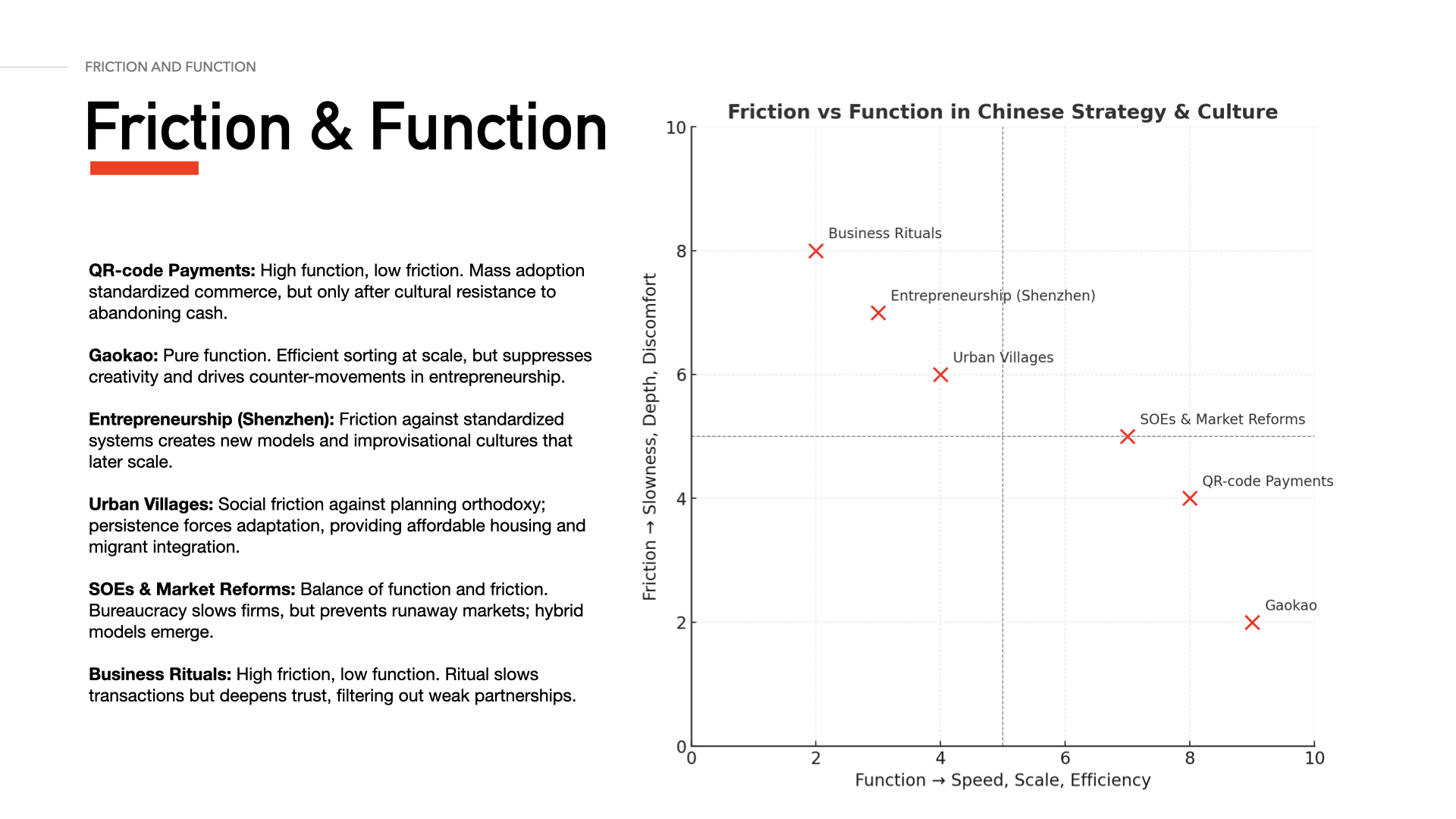
Examples across modern China show how value emerges not from pure efficiency or pure complexity, but from shifting between friction and function. QR payments moved from friction to function; urban villages preserve friction within a functional city; business rituals reintroduce friction to restore meaning.
How Leaders Read Friction
Friction costs money, and eliminating it produces measurable benefits. From Taylor’s stopwatch to Amazon’s one-click checkout, friction had to be aggressively reduced to maximize benefits. Therefore, business leaders have long been conditioned to treat friction as the enemy.
The best operators in business have always known better. The Toyota Production System, one of the most copied models of operational efficiency, gives any employee the authority to stop the entire production line if something looks amiss. Its managers are trained to physically go and check things for themselves when the data or reports don’t add up: genchi genbutsu. Rather than eliminate friction mindlessly, Toyota reads friction.
Reading friction means asking a different question first: what does this tell us that our systems don’t?
Not all friction warrants much deliberation. Much of it is waste and should be removed. A simple test distinguishes the two. First, who created it? Friction created by customers or employees, such as a workaround or a complaint, is likely telling you something. Friction you impose on customers, such as too many forms, handoffs, or approvals, is usually waste. Second, does it repeat? Recurring workarounds or complaints are design briefs. Third, what would you lose by removing it? If the answer is trust, a ritual, or craft, don’t remove it. It is likely valuable and should be protected.
Three practices enable reading friction.
Read friction before removing it. A workaround is a customer or employee designing the product you haven’t built. Resistance marks the point at which your model of the world and the world itself have parted ways. Before you smooth either one away, find out what it knows.
Go and see for yourself. The most valuable signals are often the ones no one thought to record: the customer who improvises, the market that doesn’t exist. Those signals show up as friction before they show up as data. That’s why the desk is a dangerous place to run a business.
Give friction a home. Function scales what friction discovers, and in scaling it, wears the meaning away. So keep the cycle turning. Set aside small spaces, friction labs, where teams can notice friction and explore it without the pressure to scale. They help the organization identify areas it does not yet understand.
All of these take empathy: seeing the problem as the person improvising sees it. Friction shows you where your noncustomers (people who reject your offering or never consider it) are, and they are the prime source for finding growth opportunities. (5)
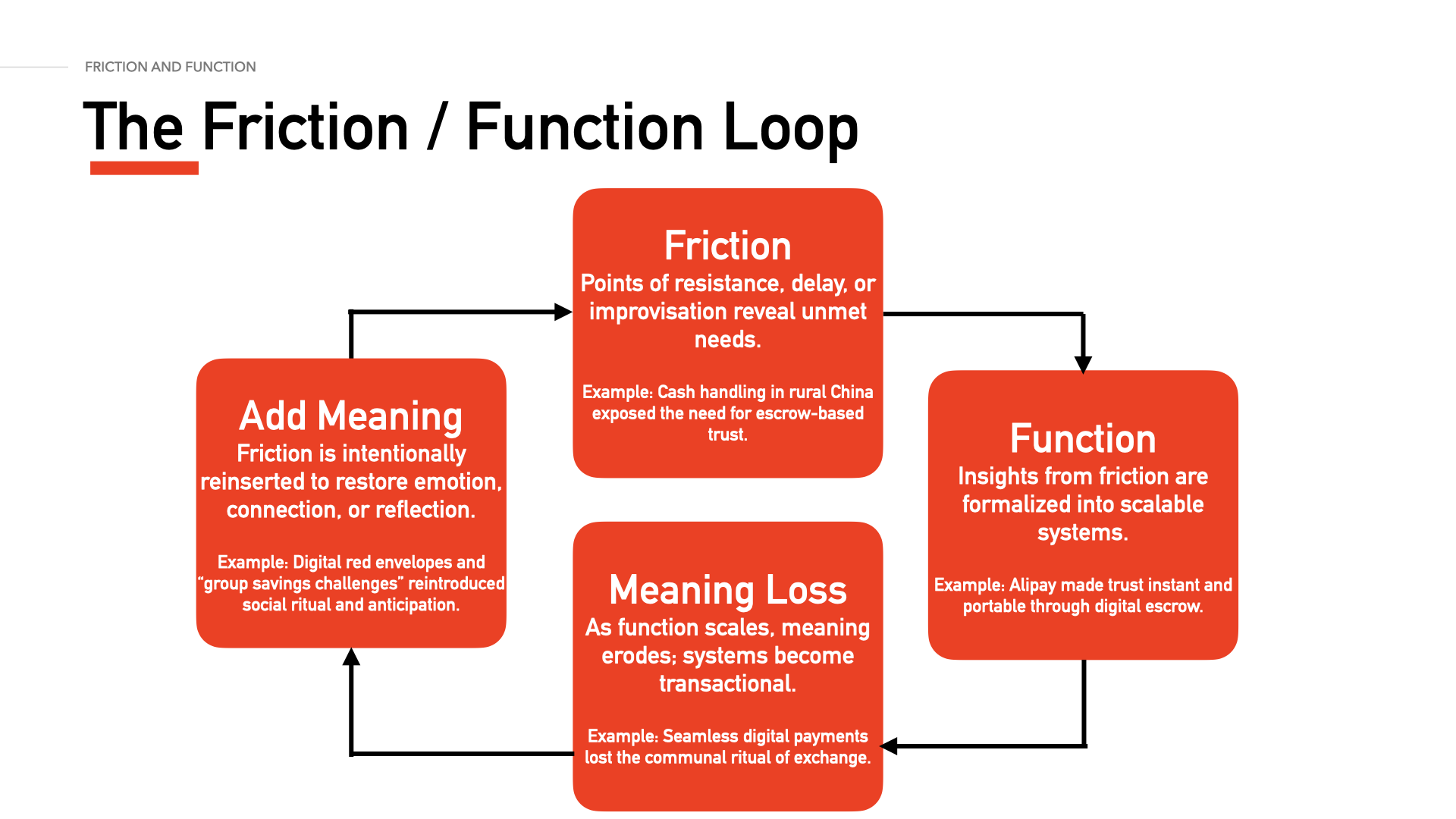
Innovation emerges through a repeating cycle: friction reveals unmet needs, function scales solutions, meaning erodes as systems optimize, and friction is later reintroduced to restore texture, emotion, and connection.
Paid to Not Know
The IBM researcher Hans Peter Luhn described a “business intelligence system” in 1958, decades before the term entered common usage. He borrowed a dictionary definition of intelligence: the ability to grasp how facts relate to one another and to act on that understanding. That is judgment. Even so, his system was machinery designed to help with it. In the decades thereafter, the meaning shrank to the realm of reporting what has already happened. It is now a plain vanilla product, a commodity. For nearly 70 years, we have mistaken the machine for the definition.
A fortuitous accident or latent curiosity may reveal what doesn’t fit, what hasn’t been measured, or what hasn’t been captured in any report. That’s where the next product, the next market, and perhaps the greatest mistakes are to be found. Recognizing these insights requires admitting you don't understand.
Maybe with the AI dividend, the time and resources freed up, managers can focus on a little more friction. AI took the knowing. Agentic AI is taking the doing. Leaders were paid to know when knowing was scarce. Now the scarce thing is the nerve to not know, long enough to learn something no one else has.
——————
For more on how leaders can thrive when intelligence is abundant, see my book with Rajeev Kapur, Intelligence as a Commodity: Human Judgment as a Competitive Advantage (Wiley, December 8, 2026), available for pre-order: https://a.co/d/0gTKK7Mc
——————
(1) For more than 200 years, the most successful companies have dedicated immense resources toward gaining and sustaining an information advantage. The Rothschilds spent a fortune during the 1800s developing an extensive courier network to gain an information edge over their rivals. In 2010, Spread Networks spent an estimated $300 million to develop a fiber-optic cable to shave milliseconds off the time it took to transmit financial data from Chicago to New York. While the particular technologies may change, the competitive logic of gaining and maintaining an information advantage is constant.
(2) Todd B. Kashdan, Patrick E. McKnight, and Spencer H. Harrison, “Curiosity at Work: A Productive Inefficiency Model,” Annual Review of Organizational Psychology and Organizational Behavior 14 (2026, in press), https://doi.org/10.1146/annurev-orgpsych-012825-104832.
(3) Kathryn Jezer-Morton, “In 2026, We Are Friction-Maxxing,” The Cut, January 3, 2026, https://www.thecut.com/article/brooding-friction-maxxing-new-years-2026-resolution.html.
(4) “The Desk Is a Dangerous Place” is an immersion program we run based on the idea that managers develop a filtered view of the world from their desk. So we take them into the field to find what is hidden in plain sight.
(5) For more on noncustomers, see my earlier article, “The Power of Noncustomers,” available here: https://corners.works/insights/blog-post-title-one-43wp2